A member of NOC’s marketing team – and a complete whitewater kayaking rookie – decided to take the Intro to Whitewater Kayaking course. Here’s what she learned.
I was around eight years old when my dad finally decided I was big enough to go rafting with my cousins on the Nantahala River. It was part of our annual family camping trip tradition, and I was thrilled to be included. As fate would have it, we chose the Nantahala Outdoor Center to guide us on our adventure. That trip sparked my love for both whitewater and the Nantahala Gorge.
Since then, I’ve enjoyed participating in guided rafting trips on other Southeastern rivers like the Ocoee, French Broad, and Pigeon. The fresh air, bouncy rapids, refreshing swim breaks, and riverside snacks – what’s not to love? But despite my enthusiasm for rafting, I never felt the desire to try whitewater kayaking. That is, until I started working at NOC last summer.
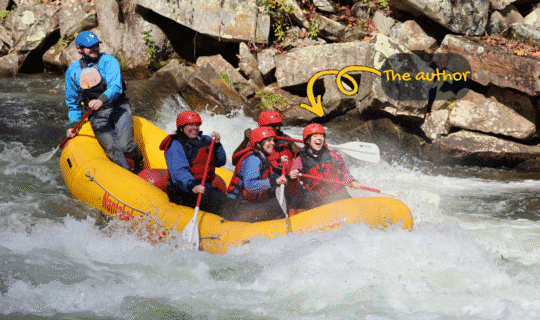
Before we keep going, I should probably introduce myself. My name is Anna-Beck, and I’m on the marketing team here! While I enjoy adventure sports like trail running and rock climbing, I’ve always been intimidated by the idea of whitewater kayaking. However, I now work alongside a bunch of paddlers, and their stoke is contagious. After a few months at NOC, curiosity got the best of me, and I signed up for the Paddling School’s Introduction to Whitewater Kayaking course with a friend. Here’s how it went.
First Things First: Selecting a Boat and Gear
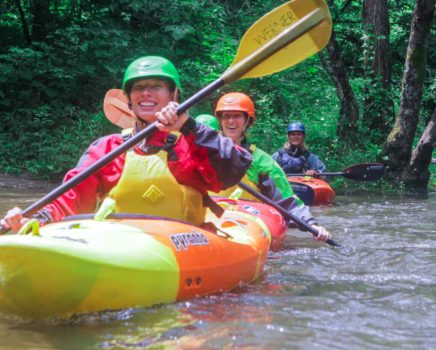
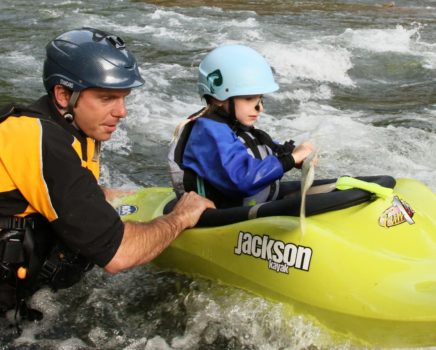
We got to the paddling school bright and early on a Saturday morning, excited but a little nervous. Ben, the course’s instructor, did a great job making us feel comfortable as we all introduced ourselves. That didn’t take long, as there were only four students in our class. A lifelong whitewater paddler, Ben has spent several seasons working for NOC’s Paddling School. After introductions, I knew we were in great hands!
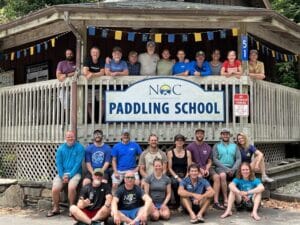
We spent the first part of our morning learning about boat selection and gear. Each student received a neoprene top and splash jacket for warmth, along with a personal flotation device and a helmet. Ben taught us how to choose the right paddle based on height and wingspan, then fitted each student with a kayak from the Paddling School’s fleet. I ended up with a half-slice kayak – these boats are known for their versatility and feature a full-volume bow and a low-volume stern, resulting in a comfortable, stable feel on the river. Ben had us sit in our kayaks and helped us adjust seats, footrests, hip pads, and thigh braces for a secure fit. After selecting our gear, we took some time to review how to hold a paddle and make basic strokes.
Then, we were ready to hit the water! The flatwater, that is.
Hitting the Lake: Paddle Strokes, Wet Exits, and Games
To get acquainted with kayaking fundamentals, we visited Fontana Lake. Only a few minutes down the road from NOC, Fontana is the perfect place to learn kayaking basics and build confidence in flatwater before hitting the river. We unloaded our kayaks from the trailer and got comfortable in our boats. Once we were all floating on the lake, it was time to cover one of the most important whitewater kayaking skills – wet exiting.
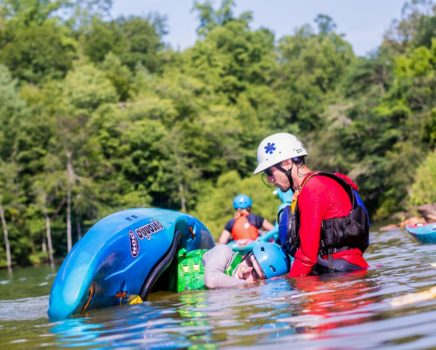
A wet exit is a simple kayaking safety maneuver used to exit a capsized kayak while wearing a spray skirt, a piece of gear that connects paddlers to their boats and keeps water out of the cockpit. When kayaks capsize, more experienced boaters can typically use an intermediate technique called a roll to return to an upright position without exiting the boat. Beginners are taught to detach the skirt from the kayak and push themselves out of the cockpit. This is necessary to master before hitting the river safely, but the idea of being upside down in water was a little anxiety-inducing for me.
Thankfully, the paddling instructors at NOC understand that wet exits can be intimidating, and they are carefully trained on how to walk students through their first attempts. While standing next to us in the water, Ben had each student intentionally capsize their boat, run their fingers around the spray skirt, yank on the pull tab, and exit. My anxiety dissipated after my first try, and actually, it was kind of fun!
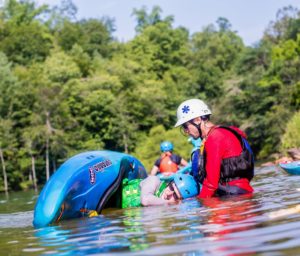
Once we all felt solid with our wet exits, we covered paddling strokes, turning, and the basics of edge control. To conclude the morning, we played games like sharks and minnows to reinforce what we learned. After a few hours on the water, we were all ready for a break. We packed up the trailer with our kayaks and headed back to NOC to eat our bagged lunches, which are included with the course. As we ate at riverside picnic tables, our instructor pointed out river features and reviewed the basics of reading water.
Testing the Waters: Practicing New Skills on the Nantahala River
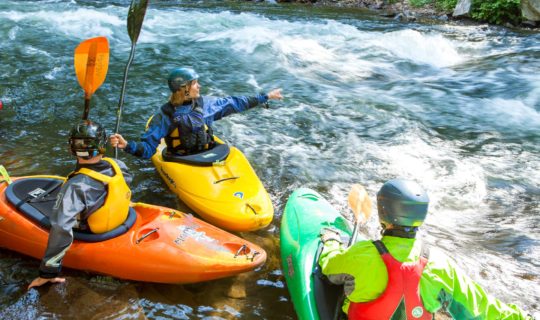
After a morning spent practicing new skills, we collectively felt stoked to get on the river. We headed to a put-in a couple of miles from NOC, excited to apply our learnings in moving water! To start, Ben chose a calmer section of the river and introduced us to another new fundamental – ferrying. Ferrying is a maneuver used to cross a river, and involves angling the boat upstream and using speed, angle, and edge control to cross the current diagonally. One by one, each student ferried across the Nantahala, gathering feedback and making adjustments in real time. Ben also reviewed how to “catch an eddy,” or approach a calm pocket of water usually found behind large rocks. We repeated this process without feeling rushed, and by the end of the exercise, I was getting the hang of it.
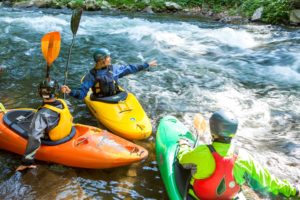
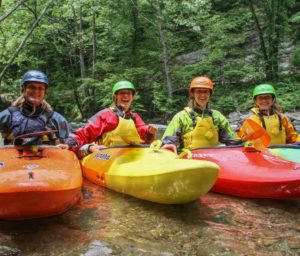
We proceeded down the river toward our first class II rapid. Ben told us how to approach the waves while keeping our boats straight, directing us to meet at an eddy afterwards. Eddies provide opportunities to stop, rest, and scout out the next section of the river. As we bounced our way through the rapids, I’m sure I had the goofiest grin on my face. It was a blast! After regrouping at an eddy, we learned how to “peel out,” a technique paddlers use to make a controlled transition from a calm eddy back into the downstream current. The rest of the afternoon followed this format – we’d hit a rapid, catch an eddy, discuss our experiences, and repeat the process while Ben gave us pointers and introduced new techniques. It was an effective and fun way to learn and make progress quickly.
Keeping the Good Times Flowing
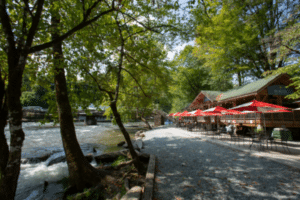
As we approached the takeout, I was sad to see the day end, but excited to continue my whitewater kayaking journey. Any anxiety I felt earlier in the day was replaced with stoke, thanks to thorough and supportive instruction – shoutout to Ben for that! After taking off my gear and putting my boat up, I said my goodbyes and went to Big Wesser to grab a burger and a drink with my friend. We reflected on the day and made plans to take the 4-Day Fundamentals of Whitewater Kayaking course, which provides more in-depth instruction on other Southeastern rivers like the French Broad and Chattooga!
A few months later, I bought a kayak at NOC’s annual Guest Appreciation Festival, which hosts a huge used gear marketplace. Stay tuned for my experience in the 4-Day Fundamentals course, which I hope to take this spring.
Ready to Start Your Own Whitewater Kayaking Journey?
I would recommend this course to anyone interested in whitewater kayaking, but if you’d like more information, give us a call at 828-785-5020 or fill out the form below. Our paddling school account manager, Jae Jackson, is a whitewater kayaker herself. She has been with NOC for 14 years and is a valuable resource when discussing your whitewater goals.
Contact the Paddling School
Paddling School Contact Form
About the Author
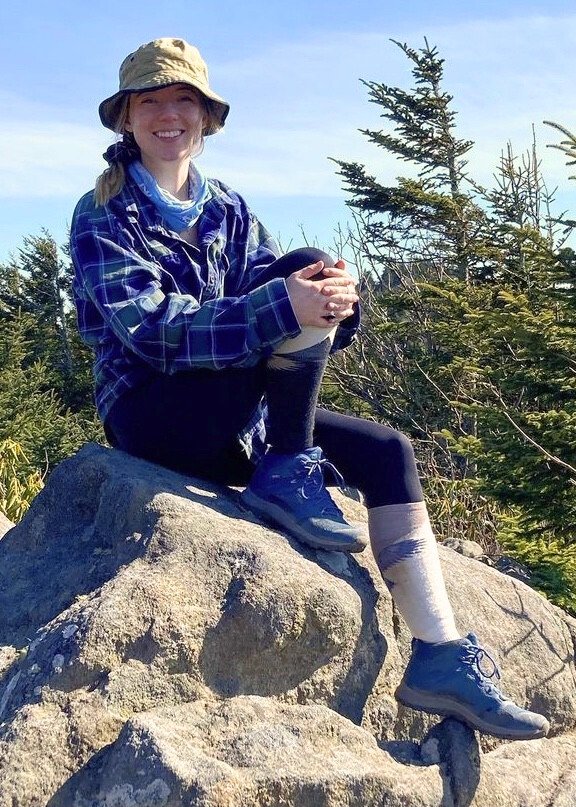
A born-and-bred North Carolinian, AB earned her undergraduate degree from UNC–Chapel Hill before kicking off a career in marketing. Last summer, she was stoked to join the Nantahala Outdoor Center as a Digital Marketing Strategist, where she combines her passion for storytelling with her love of the outdoors.
Outside of work, she can be found rock climbing, trail running, skiing, and—most recently—whitewater kayaking. With deep roots in Western North Carolina, she calls the mountains home and lives there with her very indoorsy cat, Dolly Purrton.