Cathy Kennedy: Grace Under Pressure
Cathy Kennedy Nantahala Outdoor Center
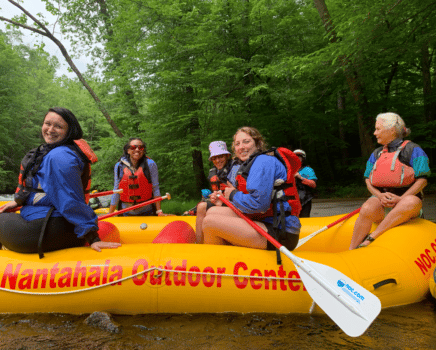
In the early summer of 1972, Cathy Kennedy was sixteen years old and had just moved to the Nantahala Gorge. That year, her parents, Payson and Aurelia Kennedy, left Georgia to help Horace Holden launch a new outdoor venture along the Nantahala River. Horace had purchased the old Tote ’N’ Tarry Motel with a vision of creating a place where families could gather to enjoy the mountains and the river. This single act helped secure outdoor recreation in western North Carolina and in the Nantahala gorge for future generations. What became the Nantahala Outdoor Center began as a simple idea: offer food, lodging, shuttles, and raft trips while welcoming members of the Chattahoochee Family Club and other people who wanted to spend more time outdoors. r
That first season was meant to be a trial summer, and everyone pitched in wherever help was needed. Guides cooked, cooks drove shuttles, staff cleaned motel rooms, it was all hands-on deck! Alongside Horace’s vision, The Kennedys and most of the young guides lived together in a house near Wesser Creek, and Cathy, along with her siblings, worked with the rest of the crew as the small operation found its footing.
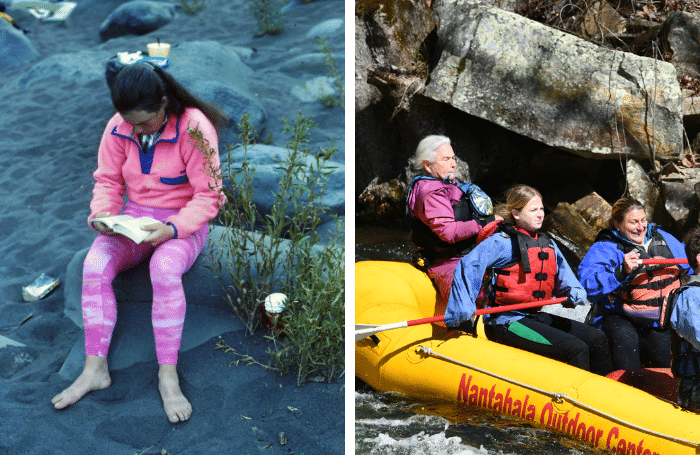
Cathy loved rivers long before the family moved to Wesser. In Atlanta, she paddled the Chattahoochee with her family whenever she could. With her dad’s competitive spirit and her mother’s love of the natural world, she quickly took to reading currents and spending long days outdoors. When her parents began planning the rafting operation in the Nantahala Gorge, Cathy was all in. For a sixteen-year-old who already loved life on the river, the move didn’t feel like leaving home. It felt like moving closer to what she loved. Like everyone else that first summer, she did what needed to be done. She worked at River’s End Restaurant, helped around the motel, and pitched in wherever there was a gap. All four Kennedy kids were part of the operation, but Cathy kept looking downstream.
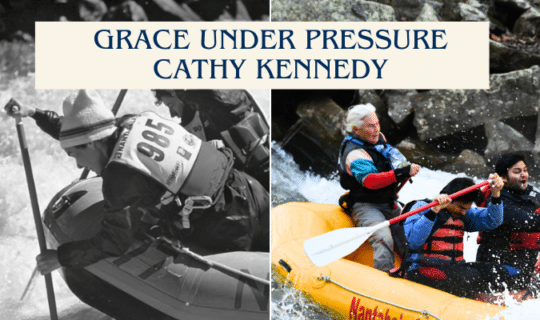
At the time, there were doubts about whether women could guide paddle rafts. The assumption at the time was simple: girls weren’t strong enough to guide. Cathy didn’t agree, but she didn’t push back with speeches. She simply asked for the opportunity to ride along. Jim Holcombe, the only guide with commercial experience, agreed to let her tag along on the daily Nantahala trip once her shift ended. She watched. She learned. She took the guide seat when she could. By the end of that first season, she was guiding on both the Nantahala and Chattooga Rivers.
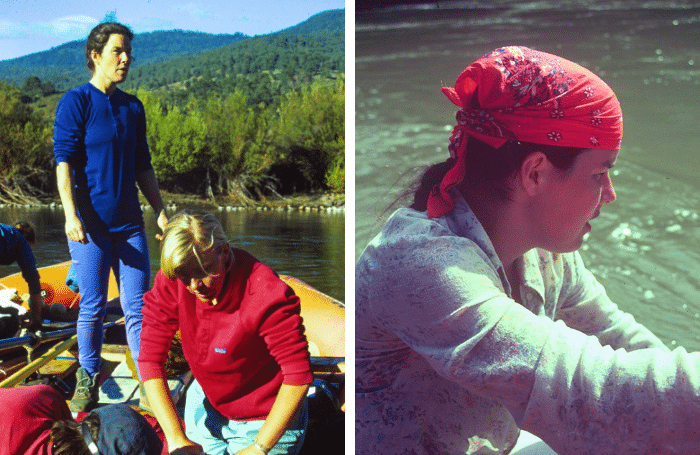
Looking back, Cathy can now claim to have been NOC’s first female guide. At the time, it didn’t feel historic. It felt like the only place she wanted to be. There were doubts in those early days. Some questioned whether a young woman could manage a paddle raft crew. Cathy didn’t spend much time trying to convince anyone. She just kept running rivers.
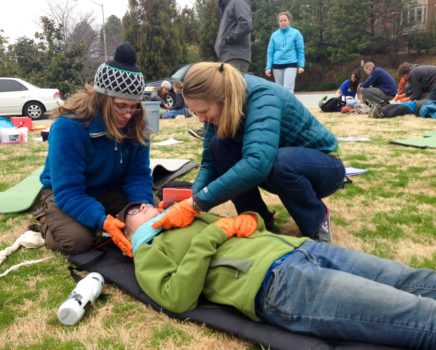
Her way of handling things started long before she ever held a guide paddle. When she was fourteen, she was at Nantahala Falls with friends when a man in their group suffered a massive heart attack. One moment, he was holding a rope for the rest of them; the next, he was in the water. Cathy moved without hesitation. She stepped in wearing hiking boots, pulled him to shore, and began CPR until others could help and an ambulance arrived. Later, on the drive home to Atlanta, she cried. “That has always been the way I deal with pressure,” she says. “Deal with what’s happening in the moment and cry about it later if I need to.” Years later, that same approach showed up on the river. Long days. Thin water. Nervous guests. Changing conditions. She focused on what was in front of her and did the work. She returned to the river the next day.
Cathy has been paddling the Nantahala for over 50 years. “The Nantahala doesn’t change much. At least not in the ways people think,” she says. “Sure, there’s a rock here and there that didn’t used to be there. An island forms or disappears. But mostly, the rivers stay the same.” After more than five decades of paddling these waters, she’s earned the right to notice the small shifts. High-water winters, low-water summers and generations of guides rotating through the outpost.
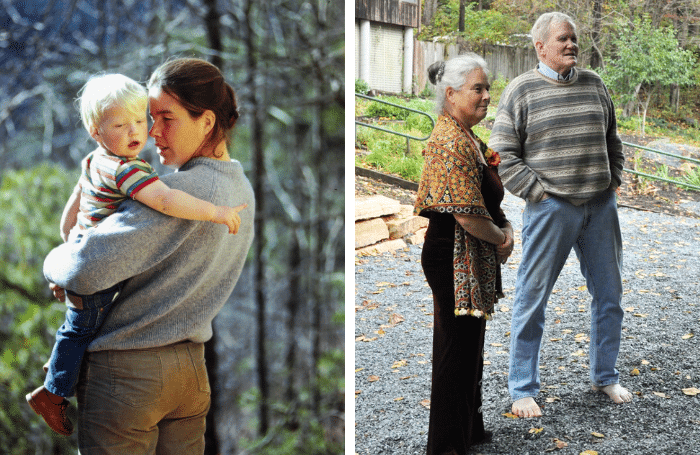
“The guides have different faces now,” she says, “but they’re a lot like the ones who came before.” That’s one of the quiet gifts of spending five decades on your home water. You begin to understand what changes and what doesn’t.
Guiding pulls her back year after year. “That’s the fun part,” she says. “Showing people the beauty of the rivers we work on and maybe something new outdoors. When other jobs get stressful, a day on the water always makes things better. Guiding itself hasn’t changed as much as people think. The equipment has improved; self-bailing rafts were a major industry shift, and paddles and PFDs are better than they used to be. But the work remains the same: read the water, manage the boat, care for your crew.”
Cathy approaches each trip with intention. Some guests want rapid names and clean lines. Others notice the plants along the bank. Cathy studied botany in school and learned foraging from her mother. If someone shows interest, she shares what grows along the river. She often sends guests away thinking about their next river.
She has seen every change and pivotal moment NOC has lived through. New gear. New faces. New expectations. What hasn’t changed is how she shows up. “Some management type once told me I needed to stop turning our best guests into staff members,” she says with a grin.
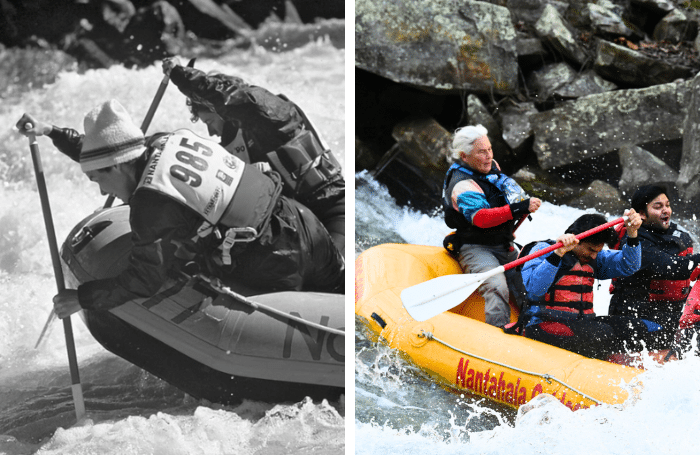
She has seen NOC grow and change over five decades. What has not changed is how she shows up. One low-water Chattooga trip still stands out. The rafts were small. The river ran thin. She carried boats upstream and worked through a day where nearly every rapid required extra effort. Other guides came back to help push her through tight spots. By the end of the day, she rode home lying on top of a raft on the bus, too tired to sit upright. That evening, she stopped by to meet a newborn baby. Her arms cramped as she held the child. The next day, she was back on the river. Cathy Kennedy Nantahala Outdoor Center
For Cathy, the river has always been more than a workplace. It’s where her children grew up without age segregation, learning from grandparents and paddling buddies of all generations. It’s where she found both challenge and calm. And perhaps that’s what the river still teaches her: how steady you must be when it matters and how to deal with what’s happening in the present moment.
Cathy Kennedy has taken more guests down the Nantahala River than anyone else in the known universe. That’s one way to measure a career. But a better measure might be this: thousands of people’s first whitewater experiences carry a little of her steady, calm in them. Not loud leadership or flashy heroics, just steady hands on a paddle and the drive to share it with the world. This is the kind of leadership the river rewards.
Cathy’s story helped open the door for generations of women on the river. Today, that spirit continues through programs designed to help women build skills, confidence, and community in the outdoors.